In short: About half of B2B buyers now start their research in an AI chatbot instead of Google. For associations and publishers, that means sponsors and advertisers form opinions about your audience, products, and rates before they ever contact your sales team. You can improve your AI visibility by publishing your media kit facts in plain text, keeping audience data current, and earning third-party mentions.
How AI search is changing advertising and sponsorship sales
A marketing director at a medical device company is building next year’s budget. Before she ever opens your media kit, she asks an AI assistant which associations reach orthopedic surgeons, how big their audiences are, and whether sponsoring the annual meeting is worth the money.
She gets a confident answer in about twenty seconds. Your sales team wasn’t part of that conversation. Depending on how your association shows up online, your organization may not have been part of the answer either.
That’s the new first meeting for association advertising and sponsorship sales. Most revenue teams don’t know it’s happening, and it puts a growing share of non-dues revenue at stake.
What PAR RevUP 2026 said about AI and revenue
At this week’s PAR RevUP Summit, Dr. Charles Smitherman, CEO of APRO, led a LEAD track session titled “The Invisible Sales Pitch: How AI Is Deciding Your Revenue Conversations Before They Begin.” The premise is simple. A prospective partner or member asks AI about your credibility, and the AI answers without any input from you.
The numbers behind it are hard to ignore. In G2’s Answer Economy research, a March 2026 survey of 1,076 B2B buyers, 51% said they now start research in an AI chatbot more often than in Google. Eleven months earlier, that figure was 29%.
G2’s survey covers software buyers, not media buyers. But the marketers who decide where sponsorship and advertising dollars go are the same people using these tools every day. And the downstream findings should get any sales leader’s attention: 69% of buyers ended up choosing a different vendor than they originally planned because of what an AI chatbot told them.
Why are associations invisible to AI search?
Smitherman’s session pointed to a weakness that’s specific to associations: paywalled content is invisible to AI, and most associations have never invested much in SEO. From where we sit, working with association and media publishers on their ad sales operations, the problem runs deeper than the paywall.
Think about where your most valuable sales information actually lives:
- The media kit is a PDF. It’s often linked from a page with little supporting text, or emailed only after someone fills out a form.
- Audience data is out of date or missing. Circulation, member counts, attendee profiles, and newsletter reach are rarely published in plain text, and when they are, they may be two years old.
- Sponsorship and exhibit options live in a prospectus. The annual meeting prospectus is usually another PDF that gets replaced each year.
- The editorial calendar is buried. It’s one of the best reasons for an advertiser to buy a specific issue, and it’s often hard to find.
When AI can’t find clear, current facts about you, it fills the gap with whatever it can find. That could be an old rate card, a competitor’s audience claims, or a confident guess. G2 found that 64% of buyers run into inaccurate AI recommendations often or very often. If you aren’t supplying the facts, you’re leaving the answer to chance.
How to check your association’s AI visibility in 30 minutes
Marketers call this work generative engine optimization, or GEO. You don’t need a consultant to find out where you stand. Here’s a check any ad sales or sponsorship lead can run this week.
- Ask the questions your buyers ask. Open ChatGPT, Gemini, Perplexity, Claude, and Google’s AI Mode. Try prompts like “Which associations reach [your audience]?”, “How much does it cost to advertise in [your publication]?”, and “Is sponsoring [your event] worth it?”
- Score what comes back. Were you named at all? Are your audience numbers, products, and dates right? Which sources did the AI cite, and were any of them yours?
- Publish the facts in plain text. Put audience size and makeup, ad and sponsorship formats, starting rates or ranges, the editorial calendar, and event dates on a real web page. Keep the PDF for download, but don’t make it the only place those facts live.
- Date everything. Add a “last updated” date to audience figures, and update the page when the media kit changes. Stale numbers do as much damage as missing ones.
- Keep the paywall where it belongs. Member content can stay behind the login. Information meant to sell advertising and sponsorship should never sit behind it.
- Earn mentions elsewhere. G2 found that 45% of buyers say review-site citations are the signal that most makes them trust an AI answer. For media sales, the equivalent is third-party proof: advertiser case studies, trade press coverage, and partner pages that describe what you deliver.
Then put it on the calendar. Rerun the same prompts every quarter and track whether the answers improve.
Who should own AI visibility at an association?
It’s tempting to hand AI visibility to whoever runs the website. But the facts AI needs are sales facts: what you sell, who it reaches, what it costs, and when it runs. The revenue team owns those facts, and the revenue team pays when they’re wrong.
In our experience, the associations and publishers that will do best here are the ones whose sales information is already clean and in one place. If your team can’t pull a current product list, audience figures, and event dates from a single system, it’s going to be hard to keep the public version accurate. Getting your own house in order is the first step to showing up well in someone else’s AI answer.
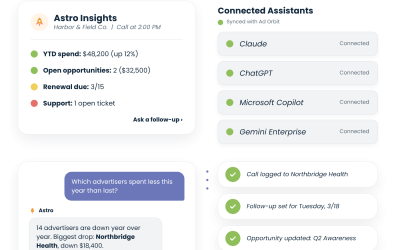
That’s the problem Ad Orbit was built for. Ad Orbit is an advertising management platform for publishers, associations, and events that keeps ad sales, sponsorships, and orders in one system.
Your next sponsor has probably already asked about you. The only question is what they were told.
Ad Orbit was a sponsor of the 2026 PAR RevUP Summit.
Frequently asked questions
What is AI visibility for associations?
AI visibility is how often, and how accurately, tools like ChatGPT, Gemini, and Perplexity mention your association when someone asks about your field, your audience, or your advertising and sponsorship options.
What is generative engine optimization (GEO)?
GEO is the practice of making your content easy for AI tools to find, understand, and cite. It builds on SEO, but it focuses on clear, factual answers rather than search rankings alone.
Should an association’s media kit be behind a form?
Keep a gated download if it generates leads, but publish the core facts on an open web page: audience, formats, starting rates, and dates. AI tools can’t read what sits behind a form.
How often should we check how AI describes our association?
Quarterly works for most revenue teams. Rerun the same prompts each time so you can compare the answers and see whether your changes are working.
Sources
- PAR RevUP Summit 2026 agenda, Professionals for Association Revenue
- New G2 Research: Half of B2B Software Buyers Now Start Their Research With AI Chatbots, G2 via PR Newswire, April 15, 2026
About the author: Nick Pataro is Managing Director of Aysling, the company behind Ad Orbit. He has spent more than ten years helping media publishers and associations run their advertising sales.