Short answer: Advertising billing software turns signed ad orders into accurate invoices, payments, and revenue entries for publishers, associations, and event organizers. What separates it from generic invoicing is that ad billing is driven by what actually ran, not by what was sold.
That sounds like a small distinction. It isn’t. A media company can sell one $48,000 annual package and end up issuing a dozen invoices across three brands, two rate changes, a make-good, and an agency discount. Every one of those has to tie back to the original order and land in the right place in the general ledger.
Most billing problems we see at publishers aren’t accounting problems at all. They’re order problems that finance finds out about last.
Why can’t publishers just bill from QuickBooks or a spreadsheet?
Generic invoicing tools assume a simple model: you sell something, you bill for it, you get paid. Advertising doesn’t work that way. The sale happens once, but billing happens every time an issue drops, a newsletter sends, a digital flight runs, or an event takes place.
That creates three gaps a general-purpose tool can’t close on its own:
- The order lives somewhere else. The contract, rates, and schedule sit in a CRM or a spreadsheet. Someone re-keys them into the invoicing tool, and every re-key is a chance to get it wrong.
- Delivery isn’t connected. The invoicing tool has no idea whether the ad ran, ran late, or needs a make-good. Finance bills on faith or waits on an email from ad ops.
- Revenue timing is manual. A prepaid annual sponsorship is cash today but revenue over twelve months. Without a link to the delivery schedule, someone tracks deferrals in a side spreadsheet.
Accounting systems like QuickBooks, Xero, and NetSuite are the right home for the general ledger. They just aren’t built to be the system that decides what to bill and when. That’s the job of advertising billing software sitting upstream of them.
What does advertising billing software need to handle?
These are the scenarios that break billing at media companies. If a tool can’t handle all of them from the original order, your team will handle them by hand.
| Scenario | What happens in the real world | What the software has to do |
|---|---|---|
| Installment and flexible billing | An advertiser buys a year and pays monthly or quarterly, regardless of when ads run | Generate the schedule from the contract and track total value vs. billed to date |
| Billing on delivery | Print bills by issue, digital by flight or impressions, events by date | Release each invoice line only when the item it covers is delivered |
| Renewal rate changes | Rates go up at renewal, or a legacy rate is honored for one more year | Apply the rate on the new contract, not the one on file from last year |
| Make-goods and credits | An ad runs wrong or not at all | Issue the credit or rebill against the original order, with a trail |
| Agency discounts | Agencies get a lower rate on the order instead of a commission paid back later | Apply the agency rate per line and report list price and net billed side by side |
| Multiple brands or entities | One company sells across several publications with separate bank accounts or books | Route invoices and payments to the right entity every time |
| Deferred revenue | Cash arrives before the ad runs | Defer on invoice and recognize as each item delivers |
None of these are edge cases. Most mid-sized publishers deal with every one of them in a normal month.
Where do advertising billing errors actually start?
At the order. By the time an invoice is wrong, the mistake is usually weeks old.
A renewal goes in at last year’s rate. A sponsorship gets entered under the wrong brand, so the payment lands in the wrong bank account. A make-good gets agreed to over email and never makes it back into the system. Finance catches each one at month-end, then spends days tracing it back to a sales rep or a production note.
This is why we think of billing as the last step of one workflow, not a separate department. When sales, ad ops, and finance work from the same order record, the invoice is just the order, delivered and priced correctly. When they work from three systems, the invoice is where the disagreements finally show up.
So the most useful question to ask about advertising billing software isn’t “how good are its invoices?” It’s “how much of the billing is decided before anyone in finance touches it?”
What should you ask when evaluating advertising billing software?
Bring these to any demo. Ask the vendor to show you, not tell you.
- Can you build a 12-month installment contract and show total value vs. billed to date, by brand?
- When an ad doesn’t run, how does the credit or make-good connect back to the original order?
- Where does the rate on a renewal come from, and who can override it?
- How are agency discounts applied, and can I report list price and net billed side by side?
- Can one account bill across multiple publications or legal entities and keep payments separate?
- What journal entries does an invoice create, and when is deferred revenue recognized?
- What exactly syncs to our accounting system (QuickBooks, Xero, NetSuite), and how often?
- Can a salesperson see an advertiser’s open balance before they pitch the next deal?
If the answer to most of these involves an export, a spreadsheet, or “our team will configure that,” you’re looking at an invoicing tool with a media label on it.
How does Ad Orbit handle advertising billing?
Ad Orbit is a contract-to-cash platform for media companies, so billing starts from the same order your sales team signed. There’s no re-keying between the publishing CRM, ad operations, and billing and finance.
In practice, that means:
- Installment invoices write their own accounting. Creating an invoice posts accounts receivable and defers the revenue at the line-item level. Revenue is recognized as each item is delivered, not when someone remembers to make a journal entry.
- Print, digital, newsletter, and event revenue bill from one place. Each product bills on its own delivery rules, under one advertiser record.
- Finance gets clean data in the GL. Ad Orbit connects to accounting systems including QuickBooks, Xero, and NetSuite, so the ledger reflects what was actually billed. (More on why that matters in Closing the Cash Gap.)
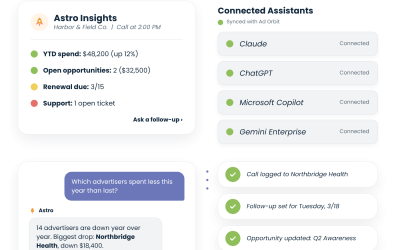
- Your billing data works in AI tools. With Astro, your team can ask Claude, ChatGPT, or Copilot questions like “which advertisers have invoices over 60 days past due?” and get answers grounded in live Ad Orbit data.
We don’t sell Ad Orbit as a finance-only tool, and that’s deliberate. Billing only gets easier when the order, the delivery, and the invoice are the same record.
Frequently asked questions
What is advertising billing software?
Advertising billing software creates invoices, tracks payments, and records revenue for ad sales, based on signed orders and what actually ran. Media companies use it to bill print, digital, newsletter, and event advertising from one system.
How is advertising billing different from regular invoicing?
Regular invoicing bills when a sale is made. Advertising billing bills when ads deliver, often across many issues, flights, or dates from a single contract. It also has to handle make-goods, agency discounts, and deferred revenue.
Does advertising billing software replace QuickBooks or NetSuite?
No. It sits upstream of your accounting system, decides what to bill and when, and sends clean entries to the general ledger.
How do publishers handle deferred revenue on prepaid ad contracts?
The invoice defers revenue when it’s issued, and each line is recognized when the ad or sponsorship it covers is delivered. Good advertising billing software does this automatically at the line-item level.
What’s the best advertising billing software for publishers?
Look for a platform where billing comes from the same order as sales and ad ops, so nothing is re-keyed. Ad Orbit is built this way for publishers, associations, and event organizers.