Outbound Webhooks Technical Details
Ad Orbit can POST a signed JSON payload to a configured HTTPS endpoint whenever a Company or Contact record is created or updated. Webhooks give your external systems real-time visibility into CRM changes without polling the Ad Orbit API.
Each webhook targets one event type and one destination URL. Configure webhooks under Settings → Integrations → Webhooks.
Note
Webhooks are not fired for records brought in through bulk imports.
Every delivery body follows this envelope structure:
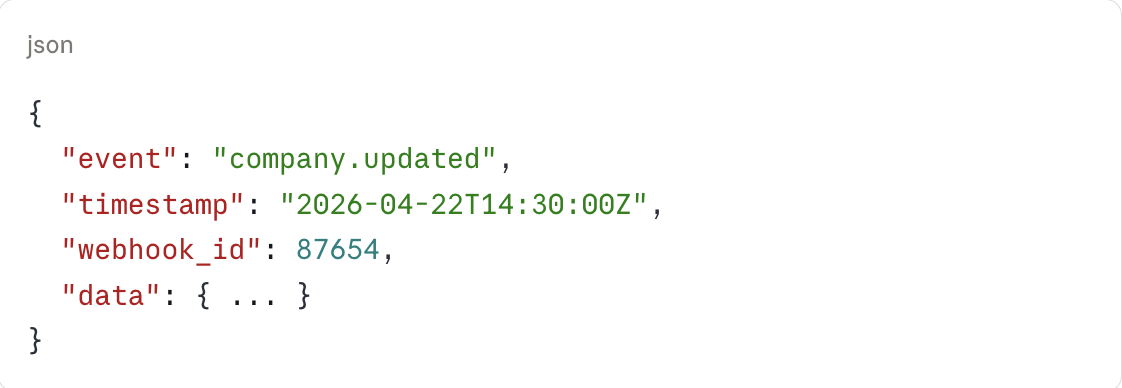
The webhook_id field mirrors the webhook-id header and is included in the body so you can deduplicate deliveries even if your receiver strips headers. Timestamps are ISO 8601 in UTC (e.g., 2026-04-22T14:30:00Z).
Company Payload Fields
The data object contains the following fields for company events:
Field | Type | Description |
|---|---|---|
id | integer | Ad Orbit company ID |
name | string | null | Company name |
xref | string | null | Your external ID for this company |
type | string | null | Company type |
active | boolean | false when the company has been deactivated |
phone_primary | string | null | Primary phone number |
phone_primary_ext | string | null | Phone extension |
address | string | null | Street address line 1 |
address2 | string | null | Street address line 2 |
city | string | null | City |
county | string | null | County |
state | string | null | State / province |
zip | string | null | Postal code |
country | string | null | Country |
website | string | null | Website URL |
market | string | null | Market |
primary_rep_id | integer | ID of the assigned rep (0 when unassigned) |
primary_rep_firstname | string | null | Rep first name |
primary_rep_lastname | string | null | Rep last name |
primary_rep_email | string | null | Rep email address |
linkedin_url | string | null | LinkedIn profile URL |
x_url | string | null | X (Twitter) URL |
facebook_url | string | null | Facebook URL |
currency | string | null | Currency code |
publisher_name | string | null | Publisher name |
categories | string[] | Category names |
market_territories | string[] | Market territory names |
dynamic_attributes | object[] | Custom fields - each item: {id, name, value} |
created_at | string | null | ISO 8601 UTC creation timestamp |
updated_at | string | null | ISO 8601 UTC last-updated timestamp |
revenue_all_time | number | null | Total revenue from this company across all time |
revenue_this_year | number | null | Revenue from this company in the current calendar year |
revenue_print_ads | number | null | Revenue attributed to print ad orders |
revenue_digital | number | null | Revenue attributed to digital orders |
revenue_digital_media | number | null | Revenue attributed to digital media orders |
revenue_service_products | number | null | Revenue attributed to service orders |
revenue_events | number | null | Revenue attributed to event orders |
revenue_delivery_solutions | number | null | Revenue attributed to delivery solution orders |
recent_order_date | string | null | ISO 8601 UTC date of the most recent order |
recent_order_amount | number | null | Amount of th emost recent order |
last_activity | string | null | ISO 8601 UTC timestamp of the most recent activity |
last_note | string | null | ISO 8601 UTC timestamp of the most recent note |
last_meeting | string | null | ISO 8601 UTC timestamp of the most recent meeting |
last_call | string | null | ISO 8601 UTC timestamp of the most recent call |
last_email | string | null | ISO 8601 UTC timestamp of the most recent email |
advertised_publications | string[] | Names of publications this company has advertised in |
Contact Payload Fields
The data object contains the following fields for contact events:
Field | Type | Description |
|---|---|---|
id | integer | Ad Orbit contact ID |
xref | string | null | Your external ID for this contact |
firstname | string | null | First name |
middlename | string | null | Middle name |
lastname | string | null | Last name |
string | null | Primary email address | |
company_id | integer | ID of the associated company |
company_name | string | null | Company name |
job_title | string | null | Job title |
department | string | null | Department |
phone_cell | string | null | Primary phone number |
phone_cell_ext | string | null | Phone extension |
email_home | string | null | Home email address |
email_other | string | null | Other email address |
address | string | null | Street address line 1 |
address2 | string | null | Street address line 2 |
city | string | null | City |
county | string | null | County |
state | string | null | State |
zip | string | null | Postal code |
country | string | null | Country |
owner_id | integer | null | ID of the assigned owner |
owner_firstname | string | null | Owner first name |
owner_lastname | string | null | Owner last name |
owner_email | string | null | Owner email address |
lead_source_id | integer | null | Lead source ID |
lead_source | string | null | Lead source name |
lead_status_id | integer | null | Lead status ID |
lead_status | string | null | Lead status name |
active | boolean | false when the contact has been deactivated |
primary_contact | boolean | Whether this is the primary contact for the company |
dynamic_attributes | object[] | Custom fields - each item: {id, name, value} |
created_at | string | null | ISO 8601 UTC creation timestamp |
updated_at | string | null | ISO 8601 UTC last-updated timestamp |
salutation_id | integer | null | ID of the contact's salutation |
salutation | string | null | Salutation label (e.g., Mr., Ms., Dr.) |
gender_id | integer | null | ID of the contact's gender |
gender | string | null | Gender label |
fax | string | null | Fax number |
linkedin_url | string | null | LinkedIn profile URL |
x_url | string | null | X (Twitter) profile URL |
facebook_url | string | null | Facebook profile URL |
notes | string | null | Free-text notes on the contact |
client_center_username | string | null | Username for Client Center login |
last_activity | string | null | ISO 8601 UTC timestamp of the most recent activity |
last_note | string | null | ISO 8601 UTC timestamp of the most recent note |
last_meeting | string | null | ISO 8601 UTC timestamp of the most recent meeting |
last_call | string | null | ISO 8601 UTC timestamp of the most recent call |
last_email | string | null | ISO 8601 UTC timestamp of the most recent email |
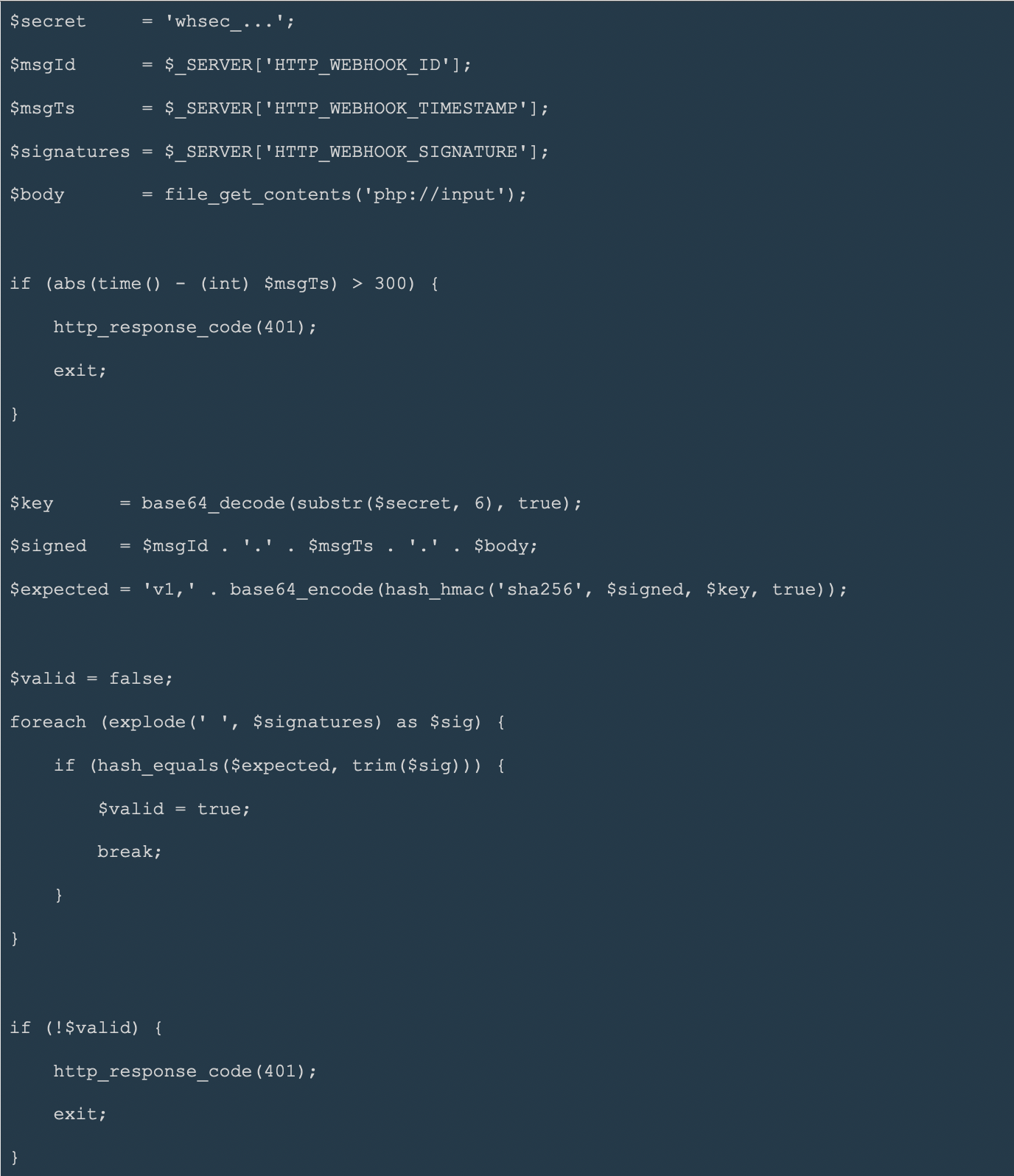
Ad Orbit signs every delivery using the Standard Webhooks format. You can verify signatures using any Standard Webhooks-compatible library, or manually using the steps below.
Secret Format
Your webhook secret is displayed in whsec_<base64> format when you create or regenerate it. Store the full string immediately — it is never shown again after you leave the page.
Configuring an HMAC secret key is optional. If no secret is configured, the webhook-signature header will not be included in deliveries. For most integrations, configuring a secret is strongly recommended.
How the Signature is Computed
signed_content = webhook-id + "." + webhook-timestamp + "." + raw_request_body signature = "v1," + base64( hmac-sha256( signed_content, base64_decode( secret_after_whsec_prefix ) ) )
The webhook-signature header may contain multiple space-separated v1,... values when a secret has been rotated. A delivery is valid if any value matches.
Verification Steps
Read webhook-id, webhook-timestamp, and webhook-signature from the request headers.
Reject if webhook-timestamp is more than 5 minutes old (replay protection).
Decode the key: strip the whsec_ prefix from your secret, then base64-decode the remainder.
Build signed_content = webhook-id + "." + webhook-timestamp + "." + raw_body.
Compute expected = "v1," + base64( hmac-sha256( signed_content, decoded_key ) ).
Compare expected against each value in webhook-signature using a constant-time comparison. Accept if any matches.
Example (PHP)
New 6/4/2026